
Most people buying commercial property focus on inspections, price, and financing. Timing rarely comes up. But when you order and complete an ALTA land survey often determines whether a deal closes on schedule or falls apart at the last minute.
The survey connects to several other steps in the transaction. Lenders need it before they approve the loan. The title company needs it to finish their review. The attorney needs it to check the legal description. When the survey is late, all of those steps get delayed too.
Why Waiting Until the Last Minute Creates Real Problems
Most commercial contracts give buyers 30 to 60 days for due diligence. Some buyers wait until that window is almost over before ordering the survey. That is a mistake.
A surveyor has to research property records, do fieldwork, and write up a final certified document. For a standard commercial property, that takes two to four weeks. If there are revisions, it takes longer.
When the survey comes back in the final days of due diligence, there is no time left to fix anything. Suppose the survey finds an easement running through a planned building area, or a structure sitting over the property line. Solving those problems takes time. If the buyer asks for a contract extension, the seller may push back.
The buyers who avoid these problems order the survey right after signing the contract, not weeks later.
Why the Review Period Matters Just as Much as the Survey Itself
Getting the finished survey is not the end of the process. It is the beginning of a review stage that involves several people. Each one needs enough time to do their job properly.
The title company checks the survey against the title commitment. They want to confirm that the boundaries, easements, and improvements on the survey match what the public records show. The lender reviews the survey to make sure it meets their loan requirements. Many lenders also need specific items included in the survey before they will approve the loan. The attorney reads the legal description and flags anything unclear before closing.
These reviews do not happen at the same time. They happen one after another. If the title company finds an issue and sends it back to the surveyor, the surveyor must fix it, re-certify the document, and send it out again. Then the lender can finish their review.
For the closing to stay on track, the survey should be done and shared with all parties at least two to three weeks before the closing date.
Problems That Show Up Between the Title Commitment and the Survey
The title commitment and the survey tell different stories. The title commitment shows what is recorded in public documents. The survey shows what is actually on the ground. Those two do not always match.
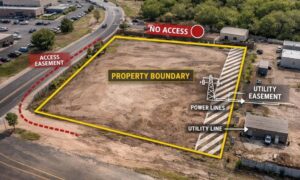
Here is a common example. A utility easement from decades ago may appear in the title commitment as a standard exception. When the surveyor maps it in the field, it runs right through a spot where the buyer wants to build. The title company knew the easement existed. Nobody knew exactly where it was until the survey was done.
Other mismatches include structures sitting over property lines, legal descriptions that do not match the plat, and access routes that were used for years but never legally recorded.
Finding these problems early gives everyone time to work through them before the closing date becomes a crisis.
How to Keep Everyone Moving in the Same Direction
A commercial closing involves surveyors, lenders, title companies, and attorneys. When they each wait for someone else to go first, delays stack up fast.
A typical version of this: the lender waits for the final survey. The title company waits for the lender’s comments. The attorney waits for the updated title commitment. By the time everyone finishes, the closing date has already passed.
The fix is simple. Get everyone aligned before the survey is even ordered. Confirm what the lender requires from the survey so the surveyor can include those items from the start. Share the current title commitment with the surveyor before fieldwork begins so they know which easements to focus on. Set deadlines for each review and follow up as those dates get close.
A little coordination early in the process prevents a lot of scrambling at the end.
How Long a Commercial ALTA Survey Actually Takes
There is no single answer. Every property is different.
A smaller commercial lot with a clean history and existing survey records might take two weeks. A larger parcel with irregular boundaries, many recorded easements, and limited prior documentation might take four to six weeks. Properties that require communication with neighboring owners or local agencies can take even longer.
After the surveyor delivers the document, the review process adds more time. Most first reviews come back with at least some revision requests. The second submission and final certification add a few more days before the document is ready for the lender.
A practical rule: plan for at least four to five weeks between ordering the survey and having a final document ready for closing on a standard commercial property. For larger or more complicated parcels, plan for six to eight weeks. Build that time into the contract before the due diligence period starts, not after.